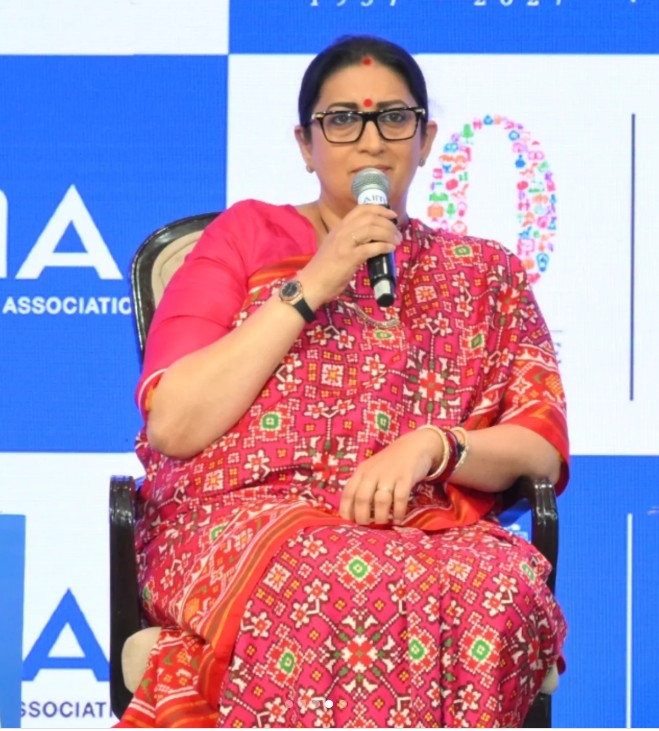
Women must not treat success as a concession or token, but earn it through talent, resilience and confidence, letting their capability command genuine respect, said Ms Smriti Zubin Irani, Former Union Cabinet Minister, Government of India and Young Global Leader, World Economic Forum at AIMA’s 70th Foundation Day and 20th National Management Day.
At a time when we are celebrating progress in women’s leadership, I believe it is equally important to question some of our long-held assumptions. For years, there has been a belief that education and corporate exposure will naturally translate into equity. If that were truly the case, we would not be witnessing the persistent gaps that continue to exist across organisations.
The reality is that while women form a significant share of the workforce, their representation declines sharply as we move up the corporate ladder. I often describe this as a “broken ladder.” The issue is not a lack of talent—there is absolutely no dearth of capable, qualified women. The real concern lies in the absence of a cohesive and collaborative effort across industry leaders to address this challenge with urgency and intent. Identifying the problem is one thing; acting on it meaningfully is quite another.
Another dimension that deserves far greater attention is the psychological environment within organisations. While legislative frameworks and policies have been put in place, the question we must ask ourselves is whether women feel secure enough to fully rely on them. The hesitation to report issues or even to avail benefits like extended maternity leave often stems from a deeper fear—of being judged, sidelined, or losing growth opportunities. These are realities that policy alone cannot fix.
I also believe we must stop framing these challenges solely as “women’s issues.” The desire to build a family, to raise children, or to balance professional and personal responsibilities is not exclusive to women. These are shared societal realities. The way leadership responds to them determines whether organisations truly become inclusive or remain selectively accommodating.
If we are serious about driving change, we must connect the conversation on equity with economics. Advocacy, while important, is not enough. When organisations clearly see and understand the business value of having more women in leadership, the shift from intent to action becomes far more likely. Evidence exists globally—we simply need to reinforce and apply it consistently.
At the same time, I would urge women to take ownership of their own journeys. Systems will evolve, but they may not do so fast enough. We must be prepared to assert our value, negotiate with clarity, and create opportunities where they do not exist. If a ladder is not offered, we must be willing to build one.
I have always believed that success should not come with a qualifier. I do not aspire to be recognised as the best woman in the room, I aspire to be recognised as the best in the room. That distinction is critical.
Real change will require effort at every level—within organisations, within leadership, and within our own homes. Inclusion is not something we merely talk about; it is something we must actively practice, every single day.
Watch the full session- https://www.youtube.com/watch?v=sdwKmcu_qz0&t=12s


