
It has become difficult to ignore the harmful changes in our planet’s life-supporting ecosystem because of humanity’s accelerated consumption of natural resources. The biggest contributor to climate change is the excessive burning of fossil fuels to power economic growth. While the West can be accused of hypocrisy for advocating conservation after benefiting from the planet’s resources, the reality remains that humanity will suffer if global temperatures continue to rise.
Keeping that in mind, India should find less polluting ways to increase income and consumption. It can turn the climate crisis into an opportunity by becoming a leader in new technologies related to energy, manufacturing, and transportation. Indian companies should focus on innovations in energy efficiency and sustainable materials.
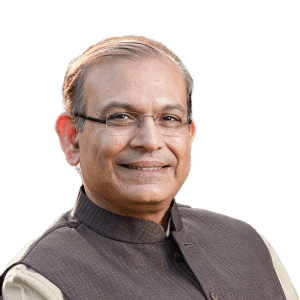
The green economy is expected to become as important as digital technology is today. India must position itself strongly in the race toward a greener future. As a global strategy expert, philanthropy strategist, and successful politician, Jayant Sinha addressed AIMA’s LeaderSpeak session on how India can move beyond Net Zero to become Net Positive.
India’s commitment to achieving Net Zero is essential, but how can it become Net Positive, and what role can private companies play in this transformation? Jayant Sinha began his deliberation by stating that this is a cause in which everyone must participate for the sake of future generations. There is nothing more important than protecting the only planet we have. He added that his long-standing interest in the subject, combined with his academic, professional, and policy-making experience, enabled him to contribute meaningfully to this cause.
He said that nearly everything we are doing today must change if we are to achieve Net Zero. Economists often describe development as a farm-to-factory process, where factories increase production through technological advancement. The next stage involves expanding production further through industrialisation and urbanisation.
The roadblocks on this journey include pandemics, climate change, water shortages, land scarcity, and air pollution. Therefore, he believes that the traditional farm-to-factory model is no longer sustainable. India must commit to bending the emissions curve and achieving Net Zero by 2070, which will require significant policy reforms.
The responsibility also lies with companies to adopt the Net Zero model while creating employment opportunities. Instead of generating brown jobs, businesses should focus on creating green jobs. For example, a person working on a farm could be employed as the driver of an electric vehicle for platforms such as Ola or Uber instead of driving a CNG-powered autorickshaw.
This approach is known as the "Green Frontier," which encompasses Net Zero emissions, high job creation, robust economic growth, and sustainable urbanisation. Green technologies—including renewable energy, biofuels, electric vehicles, battery storage, green hydrogen, and recycling—are becoming increasingly competitive compared to traditional brown technologies such as coal, petrol, diesel, and inefficient material usage. The Net Zero pathway offers a more sustainable and cost-effective development model while delivering higher productivity.
The private sector, in particular, must invest in the Net Zero transition through a decarbonisation strategy. This will enable the economy to evolve into a Green Frontier Economy. In terms of capital investment, India needs an additional investment of approximately 2–3 trillion dollars. The country must nearly double its current capital expenditure. As a result, economic growth, employment opportunities, and GDP (Gross Domestic Product) are expected to increase. Socially, reducing carbon emissions will also improve air quality and help prevent premature deaths.
He concluded by saying, "An Atma Nirbhar Bharat is a Net Zero Bharat." According to him, the pillars of a Net Zero Bharat are competitiveness, sustainability, and resilience. To build a sustainable, competitive, and resilient economy, India needs a new development model—a Green Frontier Development Model—that will place the country firmly on a Net Zero trajectory.
Watch the full session- https://www.youtube.com/watch?v=9gVQLJ-PzG0